
Low-flow gas meters
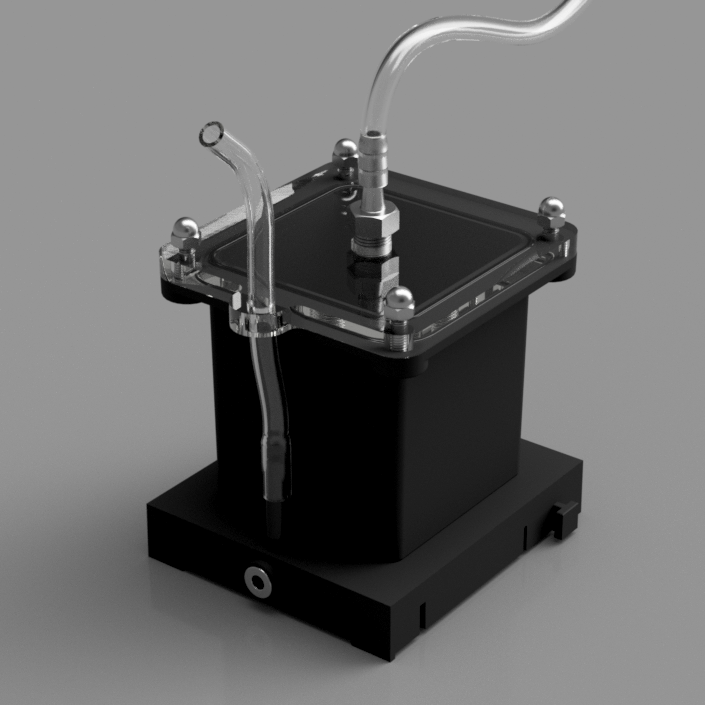
The tipping bucket principle for low-flow gas measurement was first described by the Water Research Centre UK (WRc) in 1976, and workshop-built versions were used successfully in many laboratories. We have redesigned the original concept and now use injection-moulded components to give an easily serviceable and reliable modular design.
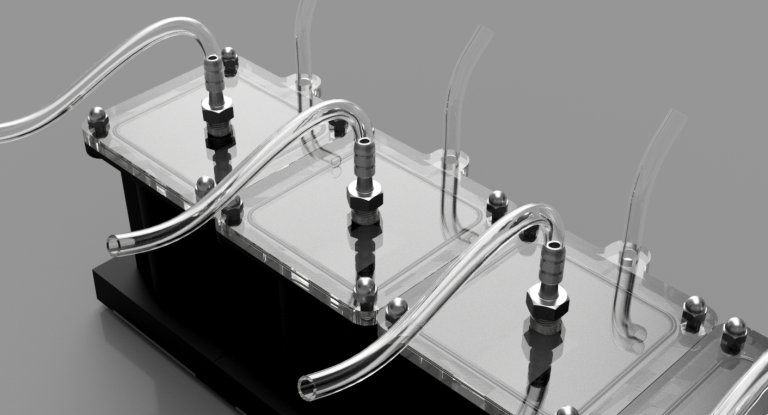
Up to 8 individual flow meters can be linked directly to a Pico Logger using 3.5 mm jack plug leads. Up to 4 banks of 4 gas flow meters (16 total) can be linked to a DAS unit via a 6-pin mini DIN plug.
- Proven ‘tipping bucket’ design (short video )
- 2 sizes available to meet a range of flow rates
- Gas-tight lid allows off gases to be collected for analysis
- Modular design allows use as a single unit or, by clipping together, as a bank of meters
- High accuracy and reproducibility
- Can be used with a DAS unit, a Pico Logger, or your own interface
CJC Labs design
In our design, the tipping bucket of the flow meter is mounted inside a vessel on a stainless steel saddle with stainless steel pivot pins. Gas enters centrally in the base and small bubbles accumulate on one side of the two-compartment inverted bucket. As the buoyancy alters the bucket tips in its saddle, releasing the accumulated gas and presenting the second compartment to the gas inflow. Each time the bucket tips, a magnet (sealed in the bucket) passes an externally-mounted Reed switch which sends a 'count' pulse to the DAS.
The small low-flow gas meter has a nominal bucket volume of 6 mL, making it suitable for flows from 6 to 10,000 mL/day. The larger meter has a bucket volume of 25 mL suitable for flows up to 100 L/day.