Configured BMP Systems
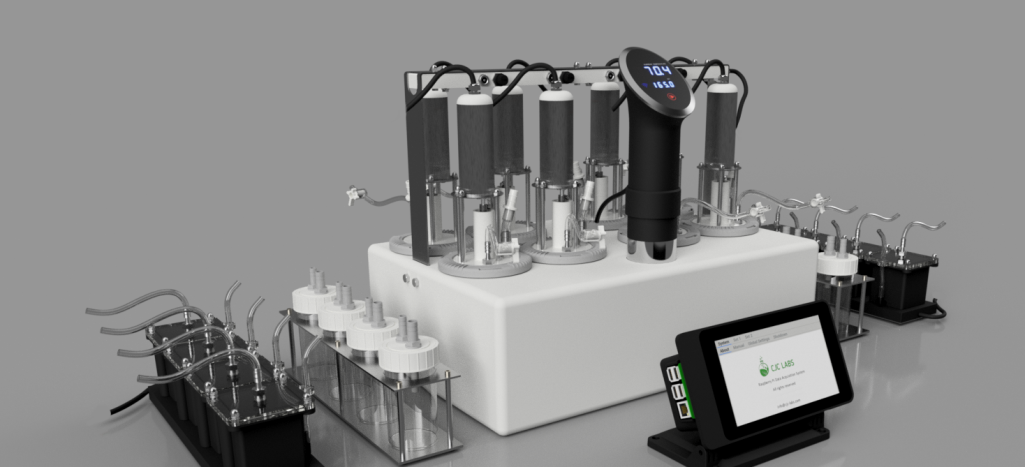
- The reactor vessel has a full-width top opening, making it easy to fill with inoculum and substrates. The wide opening allows us to use a robust and well-designed stirrer for mixing the contents (important with food and other semi-solid waste).
- Each reactor has its own gas scrubber and flow meter for gas flow measurement. The gas can also be collected downstream of the flow meter, allowing a confirmatory final volume to be measured and composition analysed (if desired).
- The reactor and gas scrubber both use a double 'o'-ring sealing system which is generally accepted as the best way to guarantee a leak proof vessel. (Click here to see a practical video on leak testing).
- Each motor is individually plugged into a power bridge, to simplify set-up and leave no messy wires cluttering the bench.
- The water bath is enclosed to minimise evaporation, and is made from HDPE which is more robust and resistant to corrosion than stainless steel baths
- The water bath design allows a simple commercially-available 'sous vide' heater to be used which gives a temperature accuracy of around 0.1 degree C. These heaters can be bought from many suppliers and online.
- We use a data logging system which does not need a PC. It uses Linux (more stable than Windows) and ARM technology, meaning it can run on a mobile phone battery back-up for several hours if necessary (useful in countries with power cuts).
- The software does real time gas volume conversion to STP.
- A set has 8 reactors, but it is more common to operate 2 sets (16 reactors) which run on a single data acquisition system (DAS).
- The system can be modified to run in fed batch mode for more extensive testing of substrates under pseudo-steady state conditions.
CJC Labs systems are not restricted to a single specific purpose: the components we supply can be matched to user-defined requirements and still remain flexible and adaptable as lab needs change.
Key features of the CJC Labs BMP System